Subscribe to immit jobs
Hand-picked jobs in Japan that need your Japanese. Written up in English, with visa and language details included. For N2+ learners.
NHK News Web Easy: Free Japanese reading + how to remember it | immit
It was a Saturday morning. I had a coffee, an hour, and an NHK News Web Easy article about a small town in Niigata reopening a 100-year-old school building. Three sentences in, I hit 蓄積. I clicked over to Jisho in another tab, typed it in, read the definition, switched back to the article, and immediately could not remember where the sentence had been going. I finished the article in twenty minutes. I read four words I did not know, looked them all up, and a week later could only define one of them out of context.
This is the experience a lot of intermediate Japanese learners have with NHK News Web Easy. The reading source is great. The looking-up is fine. The remembering is the part nobody designs for, and it is the part that decides whether you actually grow your vocabulary or just feel like you should be growing your vocabulary.
This post covers what NHK News Web Easy is, why it is the best free website for learners who want to read news in easy Japanese, where it stops being useful, and a 4-step reading routine using immit that closes the lookup-to-retention gap on the same page.
What NHK News Web Easy is
NHK News Web Easy is a free Japanese news service from NHK, Japan's public broadcaster, that rewrites selected daily articles in simpler Japanese for learners and for school-age Japanese children. Each article features furigana readings above every kanji character, audio narration so you can listen to the article read aloud while you read along, color-coded nouns that mark names of people, places, and companies, and direct links to the original native-level article for comparative reading. The service publishes around three articles per day at https://news.web.nhk/news/easy/.
The grammar and vocabulary target the upper-beginner to lower-intermediate range, roughly JLPT N4 to N3 level. Furigana can be toggled on or off, so the same article can serve as easy reading practice when furigana is on and as kanji recognition practice when furigana is off. The site does not include a built-in vocabulary saving or flashcard system, so most learners pair NHK Easy with a separate dictionary and a separate flashcard tool.
Access in 2025 and from outside Japan
NHK News Web Easy is primarily intended for users in Japan, including Japanese residents and foreign residents living in the country. Access from outside Japan has historically been open for the text and audio body of articles, but embedded video clips are typically geo-restricted to viewers inside Japan. The site is primarily designed for Japanese residents, which shapes both the editorial selection and the underlying NHK platform rules.
There have also been reports that, from 2025, parts of NHK NEWS WEB EASY require an NHK subscription fee for full access, which would limit availability for users who do not subscribe. We have not independently verified this claim against NHK's official announcements, and access conditions can change at any time. Check the live site at https://news.web.nhk/news/easy/ before relying on free access, especially if you are reading from outside Japan or planning to build a daily routine around the service..
Why NHK News Web Easy works for learners who want to study Japanese with real news
The reason NHK News Web Easy is the canonical first stop for learners moving from textbook Japanese to native input is not the news itself. The reason is the gradient. Textbook Japanese ends around N4 with controlled dialogues and reading passages designed to drill specific grammar points. Native Japanese news starts with kanji compounds, sentence structures, and topical vocabulary that no N4 reader can follow. NHK News Web Easy sits in between. Furigana on every kanji means decoding the page is never the bottleneck. Simplified grammar means the sentences resolve. Real news topics mean you are reading something an adult Japanese reader would also be reading today, which is the kind of comprehension experience textbook drills cannot deliver.
The site is also helpful for listening practice. The audio narration gives you something to listen to while you follow the written article, which trains reading and listening together. Many students who try the read-and-listen pairing for the first time find that it reveals exactly which words they recognize on the page but cannot parse in speech.
NHK News Web Easy is not designed to take you all the way to ungraded reading. Once you can read most NHK Easy articles in fifteen minutes with three or fewer lookups, the gradient flattens. The simplifications start to feel like they are removing the parts of the language you came to read. That is the point where NHK Easy graduates into bridge material rather than primary material, and the regular NHK site, manga with furigana, and light novels become the next steps.
Easy Japanese reading levels at a glance
For learners trying to map NHK Easy against where they are in their study: roughly N5 with furigana support, comfortable at N4, the natural primary source at N3, and a quick warm-up rather than a study source above N2. The "easy Japanese" label is calibrated for the N4 to N3 window, and that is where the value is highest.
A 3-step reading method for getting more out of each article
A method that works well on NHK Easy articles, and that I default to on anything new and slightly above my level, is a 3-step read:
-
Read without looking up words. Get through the article once for general meaning. Accept that some sentences will be foggy. Resist the dictionary tab.
-
Re-read with lookup for comprehension. Now hover or search the words that blocked you the first time, and re-read the sentences they were in. The second pass is where the article actually resolves.
-
Use native Japanese definitions for vocabulary growth. For words you want to remember long-term, read the Japanese-Japanese definition (a monolingual dictionary, or immit's J-J side), not just the English gloss. Native definitions anchor the word in the language itself, which is the form you will encounter it in next time.
This method works on the regular NHK site later too, and on any reading material above your current ceiling. The 3 passes feel slower in the moment and pay back per article.
The NHK Easy reading routine that doesn't stick (and why)
The default reading routine looks like this. Open NHK Easy in one tab. Open Jisho in another tab. Search for any word you do not know. Read the definition. Switch back. Find your place. Continue. Save the word to a flashcard app later if you remember to. You do not remember to.
The Yomitan plus Anki workflow improves the lookup part. Hover the word, get the definition without leaving the page. But the retention part still requires AnkiConnect, a card template, time spent in Anki later, and the discipline to review. For learners who enjoy configuration as part of the hobby, that workflow is fine and worth the setup. For learners who want to read Japanese rather than learn a tooling stack, the configuration tax is the reason the loop never sticks.
The gap NHK Easy alone leaves open is the loop from "I looked this word up" to "I remember this word the next time I see it." That is the gap immit was built to close, in one tool, on the same page, without a separate dictionary tab and without a separate flashcard app. If you want to see what the loop feels like, you can add the extension (free, no account).
A 4-step NHK News Web Easy + immit workflow
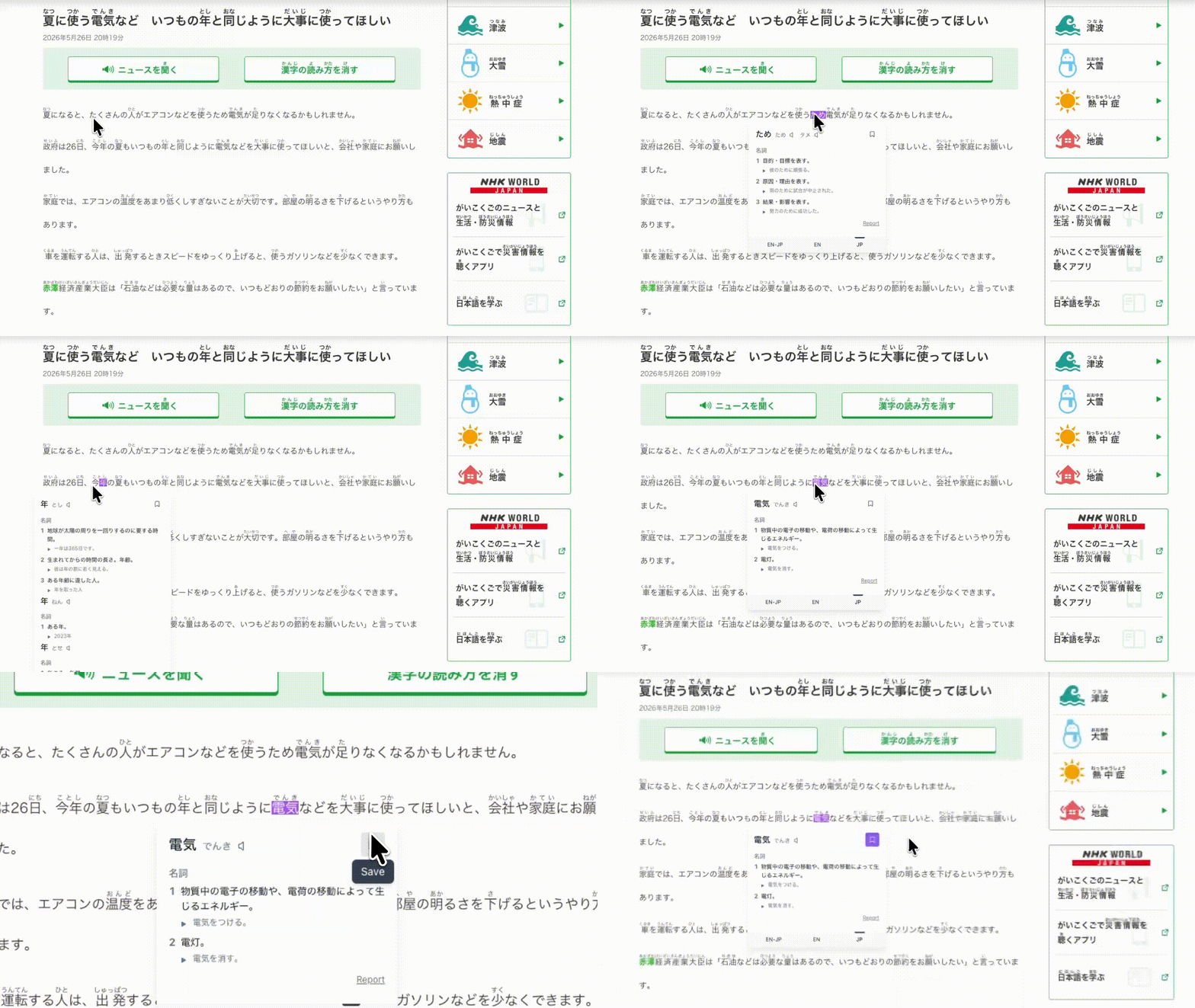 This is the reading routine I run now on NHK Easy articles. Four steps, no separate apps, no setup beyond installing the extension once.
-
Open the NHK News Web Easy article. Pick whichever one looks interesting on the front page at https://news.web.nhk/news/easy/ Start with furigana on. Read the headline and the first paragraph without looking anything up. Get the general meaning before you slow down. If you want listening support alongside the text, press play on the audio and let a native voice read the article while you read along.
-
Hover any kanji compound or word you cannot decode. immit's popup shows the reading, the definition, and example sentences in about 0.1 seconds, on the same page, without switching tabs or running a separate search. Read the definition. Stay in the article.
-
One-click save the word from the popup. A single click on the save icon adds the word to your immit flashcards. No card template to set up. No AnkiConnect bridge. The example sentence from the article comes with it, so the context is preserved.
-
Review in immit the next day. immit's built-in spaced repetition surfaces the cards you saved when you are most likely to forget them. Reviews take three to five minutes on a normal day. Cards you remember get pushed out; cards you forget come back sooner. No setup, no scheduler to configure, no add-on to install.
The full loop, from hitting a word on NHK Easy to remembering it a week later, lives inside one tool on the same page. That is the part the standard NHK Easy reading routine is missing, and it is the part that decides whether your reading time compounds into vocabulary or evaporates.
Other free Japanese reading sources for when NHK Easy gets thin
NHK Easy is the best single starting point, but no learner stays on it forever. These are the other free and low-cost Japanese reading sources worth knowing about, in roughly the order most learners encounter them.
Watanoc
Watanoc is a free news and reading website written in "Easy Japanese," recommended for learners at the N3 to N5 level. Articles include furigana, and topics are lighter than NHK news, with culture, food, and lifestyle pieces. A useful supplement when NHK Easy's news-only diet starts to feel narrow.
Todai
Todai is a smartphone app that surfaces Japanese news articles sorted by difficulty, with built-in word lookup and toggleable furigana display. Good for the train-commute reading window when a laptop is not practical. (For the iPhone Safari side of mobile reading specifically, the workflow notes in How to Read Japanese on iPhone Safari (publish date TBD) cover the dictionary side.)
NHK WORLD-JAPAN
NHK WORLD-JAPAN is free and offers news in multiple languages including Japanese, English, and several others. The Japanese articles are not rewritten for learners, but the multilingual side means you can compare a Japanese article against its native-English version, which is a useful study technique for the vocabulary-acquisition phase. NHK WORLD-JAPAN is also accessible from outside Japan with fewer restrictions than the domestic NHK service.
Tadoku graded readers
Tadoku graded readers at tadoku.org are free PDF and ebook short stories at controlled difficulty levels, written specifically for Japanese learners. They start as low as absolute-beginner level and go up to the high-intermediate range. Different rhythm from news reading and worth rotating in.
Satori Reader (paid)
Satori Reader is paid (approximately $8.99 per month as of writing, verify on satorireader.com before relying on this) and offers extensively annotated graded stories with audio. Not free, but the closest paid-content peer to NHK Easy for learners who want more guided reading material with deeper notes.
What to read after NHK News Web Easy stops feeling new
The signal that you have outgrown NHK Easy is when articles take less than ten minutes and the lookups feel like they are getting easier rather than harder. At that point the bridge to ungraded native content is the next step.
The regular NHK site at https://news.web.nhk/newsweb is the natural next stop. Same topical reporting, no rewrites, no furigana. The first month feels brutal. The second month feels like reading. Run the same NHK Easy plus immit loop on regular NHK articles, except now you are saving real native-frequency vocabulary and remembering it in context.
Manga with furigana, light novels, and longer-form fiction become viable around the same time. The reading-list-building side of that transition is covered in How to read Japanese light novels online and Complete guide to reading your first Japanese novel (both publish date TBD). The point is that the same lookup-to-retention loop you built on NHK Easy with immit carries forward to every selectable-text reading surface, so you are not learning a new workflow each time you switch sources.
FAQ
What is NHK News Web Easy and who is it for?
NHK News Web Easy is a free Japanese-language news service from NHK, Japan's public broadcaster. Articles are rewritten in simpler Japanese with furigana on every kanji and automated audio narration. The service is designed for school-age Japanese children and for foreign residents in Japan, and is useful for learners abroad at the upper-beginner to lower-intermediate level (roughly JLPT N4 to N3). Access conditions may change; verify on the live site before relying on it.
Is NHK News Web Easy good for JLPT N4 or N3 learners?
Yes. NHK News Web Easy's grammar and vocabulary target the N4 to N3 range. N5 learners can read it with furigana on but will spend more time looking things up than reading. N2 and N1 learners will find the rewrites too simplified and should move to the regular NHK site or other ungraded sources.
Do I need a dictionary tool to read NHK News Web Easy?
NHK News Web Easy itself does not include a dictionary tool, so you will need one to look up unfamiliar words. A hover-based popup dictionary like immit lets you look up any word on the page without leaving the article, and adds a one-click save plus built-in spaced repetition so the words you look up actually stick.
The website has a built-in pop-up dictionary that provides definitions in simple Japanese for some words, but most learners use an external dictionary tool for broader coverage and to save vocabulary for review. A hover-based popup dictionary like immit keeps you on the page and adds the lookup-to-retention loop in one tool, which the built-in dictionary does not support.
What is the difference between NHK Easy and the regular NHK news site?
NHK Easy rewrites articles in simpler Japanese, adds furigana on every kanji, color-codes proper nouns, and includes audio. The regular NHK site at https://news.web.nhk/news/easy/ uses standard Japanese with no rewrites and no furigana. Most articles on NHK Easy include a direct link to the original native-level article for comparative reading.
Can I save vocabulary from NHK Easy for review later?
The NHK Easy site itself does not include vocabulary saving or flashcards. Pair it with a tool that adds the save-and-review layer. immit's popup includes a one-click save and built-in spaced repetition flashcards, so vocabulary you hit on NHK Easy lives in the same review queue as words from any other selectable-text source.
Is NHK News Web Easy useful for listening and conversation practice?
For listening, yes — the article audio is read by a native voice at a moderate pace, and pairing the listen-and-read together is one of the most efficient ways to train comprehension at the N4 to N3 level. For conversation practice, NHK Easy is less of a direct fit because the register is news-formal rather than spoken-casual. Use it for input, and pair it with a separate speaking practice channel (a tutor, a language exchange person, or a conversation app).
Can I access NHK News Web Easy from outside Japan?
Text and audio articles have historically been accessible from outside Japan, while embedded video clips are typically geo-restricted to viewers inside the country. There have also been reports of access changes in 2025 tied to NHK's subscription fee structure. Conditions can change, so check the live site before planning a study routine around it. If domestic NHK Easy is not accessible to you, NHK WORLD-JAPAN remains a fully free, internationally accessible alternative for Japanese news content (though not rewritten for learners).
How long should I read NHK News Web Easy per day to improve?
Most intermediate learners see steady vocabulary growth with around fifteen to thirty minutes per day, five to seven days per week. The length of the session matters less than the consistency. One short article per day with saved vocabulary that gets reviewed beats one long session per week without follow-up review.
What should I read after NHK News Web Easy gets too easy?
The regular NHK site, manga with furigana, and light novels are the standard next steps. Same lookup-and-save workflow, harder material. The bridge is gradual: most learners spend two to three months on NHK Easy before regular NHK feels readable for more than the headline.
Closing
NHK News Web Easy is the best free Japanese reading source for upper-beginner to lower-intermediate learners (subject to current access conditions — see the access note above). The gap it leaves open is the loop from lookup to retention, and that gap is the reason a lot of NHK Easy reading time feels like motion without progress.
If you want to read NHK Easy the way the loop is supposed to work, with one tool on the same page from hover to save to next-day review, immit is free on Chrome and on desktop. No account, no setup, works offline.