Complete guide to reading your first Japanese novel
I still remember opening my first Japanese novel. I had finished a textbook, I knew my kana, I could recognize a few hundred kanji, and I was sure I was ready. I read the first sentence four times and understood maybe half of it. The second sentence had three words I had never seen. By the bottom of the first chapter I had a list of twenty unfamiliar words and zero idea what was happening in the story.
If that sounds like you, or like the wall you are afraid of hitting, this guide is for you. Figuring out how to learn to read Japanese well enough to enjoy a real book is one of the biggest jumps in the whole journey, and most people bounce off it once or twice before it sticks. The good news is that the wall is not about talent or some huge number of hours you have not put in yet. It is almost always about three fixable things: starting at the wrong level, looking up words the slow way, and not holding on to the new words you look up. This article walks through all three, with a study routine you can actually keep.
A quick note before we start. immit, the tool my wife Serena and I build, is a popup Japanese dictionary with a built-in flashcard system, and it shows up later in this guide as the lookup-and-memory layer I use while reading. It is not a course and it is not the book. The reading material, the grammar foundation, and the habit are yours. immit just makes the look-it-up-and-remember-it loop fast enough that you keep going.
Here is the one thing most learners want to hear first: you are ready to start reading Japanese earlier than you think, as long as you start with the right material.
A reasonable foundation looks roughly like this. You can read hiragana and katakana without sounding them out. You have worked through beginner grammar, around the level of Genki I, which many learners treat as a gold standard starting textbook. You recognize somewhere around 300 kanji characters, which is enough to make sense of a large share of everyday text once context helps you. And you have a base of a few hundred to a thousand japanese words. Familiarity with about 300 kanji already lets you follow a lot of level-appropriate reading, and many learners find that pushing toward 1,500 known words unlocks a much wider shelf of japanese books.
You do not need to be fluent. Reading is not the reward you get at the end of your Japanese studies. Reading is one of the two main modes of immersion learning, alongside listening, and it is how a strong foundation in grammar and vocabulary actually turns into Japanese fluency. Sustained exposure to real Japanese sentences is what builds the intuition for using the language naturally, the same intuition native speakers grow up with in everyday life in Japan, and reading in Japanese improves your listening comprehension at the same time because you are meeting the same words and grammar in a new place.
So if you are waiting until you feel ready, stop waiting. Pick easier material than your ego wants, and start.
The single biggest mistake I see, and the one I made, is choosing a book that is too hard and then blaming yourself when it hurts. The fix is not more willpower. It is better material matched to your Japanese level.
Graded readers and short stories for beginners
The most reliable on-ramp is graded readers. These are short stories and books written specifically for Japanese learners, with controlled vocabulary and grammar, organized by level from absolute beginner up through upper intermediate. Many include furigana, the small hiragana printed above kanji that tell you the reading, and some include audio so you can do listening practice with the same text. Graded readers give you structured practice that is matched to where you actually are, which means you finish them, and finishing things is what keeps you reading. The free Tadoku graded readers are a great place to begin, and published learner series exist for every level above that.
Short stories in general are a smart starting format even outside dedicated graded-reader series. A short story gives you a complete arc in a few pages, so you get the satisfaction of finishing something instead of stalling forty pages into a novel you will never return to. Think of each short story as a single lesson in reading: small, complete, and repeatable.
Manga, light novels, and native Japanese books
The next rung up is manga and light novels. Manga can be a lot easier to start with than prose because the pictures carry much of the meaning, so a single sentence you only half understand still makes sense in context. Light novels (ライトノベル) sit between graded readers and literary fiction: simpler language than serious literature, lots of dialogue, and often some furigana. They are also written to be fun, which matters more than it sounds. If the story is interesting, you will tolerate not understanding every word, and that tolerance is the whole skill.
Above light novels are native Japanese books, the novels written for Japanese people rather than for learners. This is where you meet a real author's style, denser phrases, and vocabulary chosen for effect rather than for simplicity. You climb to this rung; you do not start on it.
How to choose what to read
When you are choosing, match the material to two things at once: your proficiency level and your actual interests. Online databases and websites like LearnNatively.com let you find Japanese books rated by difficulty so you are not guessing. Reading interest should win over reading perfection every time. The best first book is not the most impressive one. It is the one you will actually finish.
The ladder, in order: graded readers and short stories, then furigana-supported manga and light novels, then native novels written for Japanese readers. You do not skip rungs. You climb them.
Once you have the right book open, the moment-to-moment work of reading is a loop, and how well you run that loop decides whether reading feels like progress or like punishment.
The loop is simple. You read a sentence. You hit an unfamiliar word. You get its reading and meaning. You decide whether it is worth keeping. You read on. The two places this loop breaks down are the looking up and the remembering, so let me take each.
Looking words up without breaking your flow
Kanji makes up roughly two thirds of the text on a Japanese page, and kanji is how the language expresses complex ideas, so you will be meeting unfamiliar kanji words constantly at first. Doing that with a paper dictionary, or by copying each word into a separate dictionary site, is so slow that most people quit. A digital reader or a popup dictionary fixes this by giving you the definition the instant you point at the word, with no manual lookup and no tab switching. This is the difference between a lookup taking five seconds and taking forty, and across a single chapter that gap is the difference between finishing and giving up.
This is where immit fits into reading. immit is a popup Japanese dictionary that runs on any web page. When you read Japanese text in your browser, on a graded-reader site, an NHK Easy article, a web light-novel page, or a manga reader that renders its text as HTML, you hover over a word and a popup shows the reading, the part of speech, the definition, an example sentence, and a button to hear it pronounced. It looks up Japanese to English, English to Japanese, and Japanese to Japanese, so as you get stronger you can switch to monolingual definitions and start thinking inside the language instead of translating back to your native foreign language. There is no copy-paste and no setup; you install it and it works when you hover.
Remembering the words you look up
Here is the part almost everyone gets wrong. Looking a word up is not learning it. If you look up the same word on page 3 and page 30 and page 80 and it never sticks, you are doing lookups, not building vocabulary. Vocabulary retention comes from repeated encounters spaced out over time, which is exactly what a spaced repetition system is built to deliver, and you learn vocab far more durably when you meet it in the context of a sentence you actually read than when you memorize a list.
immit closes this side of the loop too. When you find a word worth keeping, you save it with one click, together with the sentence it appeared in, and it goes into your personal deck. From there immit's built-in FSRS spaced repetition schedules it for review at increasing intervals, so the words you met while reading come back to you right before you would forget them. You review with a simple flip mode, where you check whether you remember the meaning, or a type mode, where you type the answer and immit checks it. There are no card limits and no daily session caps, and the whole thing works offline, so reviews happen on a plane or in a cafe with no Wi-Fi. There is no account required to do any of this. The point is that looking a word up while reading and scheduling it to be remembered are the same action, instead of three different apps stitched together.
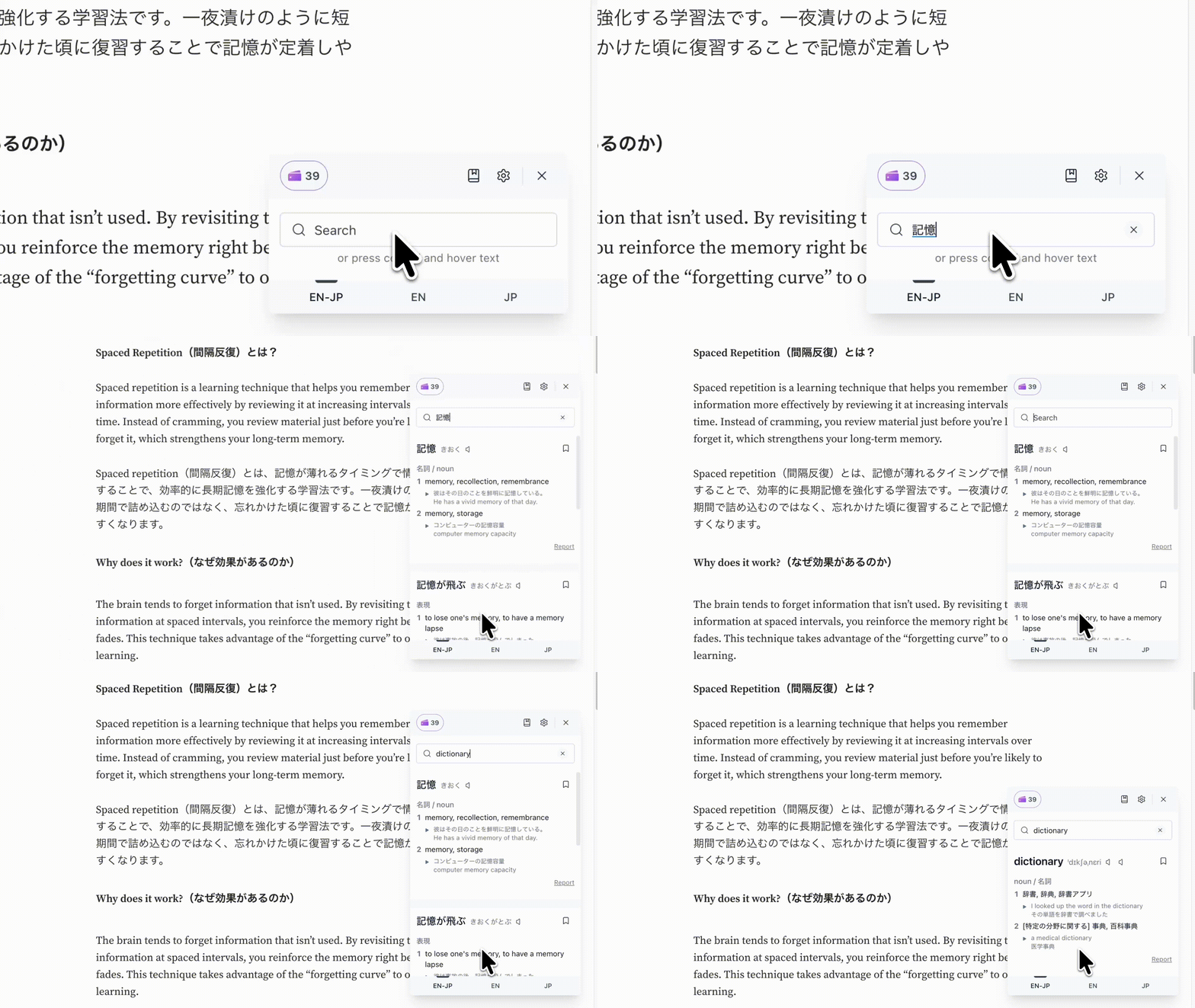
A small habit that helps while you read: immit also has a Pocket Dictionary, a small dictionary window you can pin to the corner of the page so it stays open beside the text. You can type a word into it to look something up that you are not hovering over, and you can clear a few flashcards in it during a break without leaving your book. It turns out a dictionary you read alongside is a lot less disruptive than one that jumps in front of you.
No, and trying to is one of the fastest ways to kill the habit.
If you stop at every unfamiliar word, a single page becomes a vocabulary excavation site and the story disappears. Some ambiguity is fine. The goal early on is to follow the thread of what is happening, not to translate every sentence perfectly. A useful rule of thumb: look up the words and phrases that are blocking your understanding of the sentence, and the ones that keep recurring, and save those. Let the rare, one-off words go. You will meet them again if they matter, and repeated encounters in the wild are what tell you a word is worth learning.
This is also why saving selectively beats saving everything. A deck stuffed with every word you ever hovered becomes a review pile you dread. A deck of the words that actually mattered to your reading stays light enough that you keep showing up. Read for the story, save what blocks or recurs, and let the spaced repetition handle the rest.
One habit that quietly pays off is reading aloud. Saying the sentences out loud links what you read to pronunciation and to listening, so a single text gives you reading practice and listening practice at once.
Reading aloud is also the easiest way to meet pitch accent in real material. immit does not display pitch accent marks, but the popup has a pronunciation button, so you can hear how a word is actually said and copy the pitch shape with your own voice. Early on, do not chase perfect pitch accent on every word. Read aloud, listen to the audio when you are unsure, and let your ear sharpen over time the way it does for native speakers.
Consistent daily reading beats long, sporadic sessions every time. Regular practice is what improves your reading speed, deepens vocabulary retention, and builds comprehension, and it works far better than cramming a whole book in one exhausting weekend and then not reading for a month.
A routine that works for a lot of learners looks like this. Read books a little every day, even ten or fifteen minutes, at a level where you understand most of it. Keep growing your base in parallel, aiming to learn something like 20 to 30 kanji and around 100 new words a week, because reading and study feed each other: study makes reading possible, and reading makes the studied words real. Save the words that block or recur as you read, and let your spaced repetition reviews carry them. Read aloud sometimes. And reread material you have already finished. Rereading a short story or first chapter that now feels easy is one of the most underrated ways to build reading speed and confidence.
If grammar is the thing tripping you up rather than vocabulary, shore that up with a structured grammar resource before you push into harder books. Tools like Bunpro or Renshuu are built to teach grammar step by step and pair naturally with reading: get the grammar solid, then let reading reinforce it. Reading is also a form of sentence mining, where the words and structures you pull from real sentences reinforce what you are learning in context, so the two are never really separate activities.
You do not need a huge stack of tools. You need three things.
First, a text at the right level, which means starting with graded readers and short stories and climbing the ladder toward light novels and then native Japanese books, choosing for interest as much as difficulty. Second, a fast way to look words up and a way to remember them, so that japanese reading builds vocabulary instead of just burning through lookups; this is the role immit plays, a popup dictionary plus built-in spaced repetition in one tool, free to use with no account; if you want your deck on more than one computer, syncing is free too with an optional account. Third, a solid grammar foundation, topped up with a grammar tool if that is your weak point.
That is the whole kit. A book you can finish, a loop that makes the words stick, and the grammar under it. The first novel is hard for everyone. It was hard for me. But it is a wall you climb once, and the view on the other side, reading Japanese for the story instead of for the study, is the entire reason any of us started learning to read this language in the first place.
Try immit free to set up the look-it-up-and-remember-it loop before you open your first book, or add it from the Chrome Web Store. For more on where to read, see our guide on reading Japanese light novels online.
When am I ready to read my first Japanese novel? Roughly when you have beginner grammar down (around the Genki I level), can read kana fluently, recognize around 300 kanji, and know a few hundred to a thousand words. At that point start with a graded reader or short story, not literary fiction. You do not need fluency first; reading is how you build toward it.
What is the easiest Japanese material to read first? Graded readers and short stories written for Japanese learners, with controlled vocabulary and furigana, are the easiest true starting point. After those, furigana-supported manga and light novels are a good next step because the visual context and simpler dialogue carry you through words you only half know.
Should I look up every unknown word when reading Japanese? No. Look up the words and phrases that block your understanding of a sentence or that keep recurring, and let rare one-off words go. Stopping at every word turns a page into a chore. Save the words that mattered and review them later.
Do I need furigana to read Japanese novels? It helps a lot early on, and graded readers and furigana editions provide it. immit shows furigana on the specific word you look up in its popup, but it does not add furigana across the whole page, so use a furigana edition for page-wide readings.
How do I remember the words I look up while reading? Save them and review them with spaced repetition. immit lets you save a word with one click while reading and then schedules it for review with its built-in FSRS, so words you met in a real sentence come back right before you would forget them.
Should I read on a computer or on paper? Both work for reading, but the look-up-and-save loop is fastest on the computer today. When you read Japanese on websites in your browser, immit lets you hover for instant definitions and save words to review, with no copy-paste. Paper and e-readers are fine for reading; keep the saving on the computer, and review wherever you like, including on your phone through immit's web app.
Graded readers, light novels, or real novels: which should I read first? Graded readers and short stories first, because they are written for your level and you will finish them. Then furigana-supported light novels. Then native novels written for Japanese readers. Climb the ladder; do not skip rungs.

 A small habit that helps while you read: immit also has a Pocket Dictionary, a small dictionary window you can pin to the corner of the page so it stays open beside the text. You can type a word into it to look something up that you are not hovering over, and you can clear a few flashcards in it during a break without leaving your book. It turns out a dictionary you read alongside is a lot less disruptive than one that jumps in front of you.