Renshuu vs Anki vs immit: three different answers to "how do I keep going?"

You read native Japanese most days and you already have a popup dictionary installed, but your flashcard habit has stalled, or it never really got going. So you search "renshuu vs anki" and find two tools that look like rivals. They aren't really rivals: each one answers "how do I keep going?" differently, and if reading is how you learn, there's a third answer to look at.
What is Renshuu built to do?
Renshuu is a study site with the plan already built in. Its homepage describes curated lesson packs, including pre-made lessons that follow textbooks like Genki, Tobira and Minna no Nihongo, plus JLPT and Kanji Kentei sets. If you'd rather choose your own path, the homepage lists "thousands of staff and user-made lessons" as of November 2026. You can also build a lesson from your own word list, such as the terms you need for work.
Practice comes in many forms. The homepage shows choosing the right particle for a sentence, typing a word's hiragana, putting sentence pieces in order, and listening for a missing word. Its stated idea is that understanding comes "through varied practice, not flipping a card over repeatedly." There are games too, such as one where the mascot Kao-chan fights monsters while you pick the right counter, and the page says everything can be adjusted or turned off.
Renshuu also has its own dictionaries for vocabulary, kanji, grammar and example sentences. It says it can match how Japanese is shown to your level, down to individual kanji. If you're looking for a way off Anki, Renshuu is an independent option in its own right, with lessons, quizzes and lookups all on one site. For a learner who wants a structured path with a lot of variety, it puts a great deal of study in one place.
What is Anki built to do?
Anki calls itself "a flashcard program," and its manual calls it content-agnostic. It holds Japanese vocabulary as easily as law exam facts or guitar chords. You create decks, add cards and rate your recall, and Anki schedules the next review. You can change card layouts and review timing, add-ons extend it further, and FSRS has been added as an alternative to the older SM-2 algorithm.
That openness is the point, and it's also the work. A deck starts empty until you fill it, either by hand or with a shared deck. For someone reading Japanese, the card design is yours to build and the path from a page to a card is left to other tools. The usual answer is Yomitan plus AnkiConnect, which we take apart in how the Yomitan and Anki setup works and where it breaks.
None of this is a flaw. Anki is built to schedule anything you can put on a card, with apps for Windows, macOS, Linux, iOS and Android as of November 2026, and it does that job very well.
Where does immit fit if you mostly read?
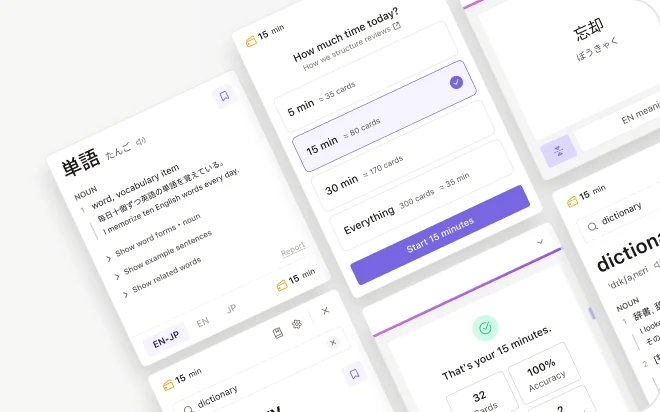
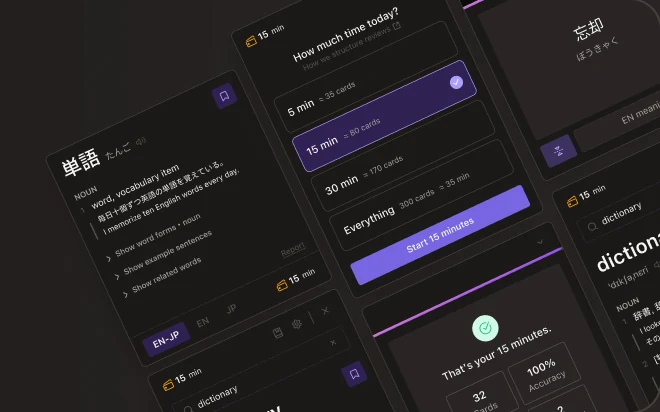
immit starts from the page you're on. Hover a word on any web page, such as a news article, a YouTube caption or a web manga reader. A popup shows the definition, part of speech, the reading in furigana, example sentences and a frequency label. Conjugated forms are handled, so 食べました is looked up as 食べる.
One click saves the word to your wordbook along with the sentence it came from, so the sentence travels with the card. Review runs on built-in FSRS, the same scheduler as Anki, and it works on a time budget. You choose 5, 15 or 30 minutes, or everything that's due, and the timer is what you commit to while the card count is only an estimate. Lookup and review are one tool, so there's nothing to connect, and we explain the reasoning in how we structure reviews.
immit's scope stops at reading and remembering. It has no curriculum, no lessons, no games and no pre-made anime or novel decks. It also has no native phone app: on a phone, you review in the browser on immit.co. If you want a path laid out for you, Renshuu covers that.
Renshuu or Anki for Japanese: which one fits you?
"renshuu or anki" sounds like one question, but it's really three, depending on how you study.
You study from lessons. Renshuu fits. It gives you textbook-aligned packs, quizzes in several formats and games you can switch off. It suits a class, an exam or a fresh start at a new level.
You build decks. Anki fits. You decide what goes on each card and how it looks, and you can tune it as far as you like. If you're the kind of learner who enjoys setting up the system, Anki rewards that.
You read. This is where immit fits, because the words you need come from the article or subtitles in front of you, not from a list someone else made. Hover, save with the sentence and review on a timer, with no deck to design and no lesson plan to follow. If you're coming from Anki, this guide to switching from Anki to immit covers what changes and what stays the same. For a wider look at structured study apps, see our comparison of Renshuu, Anki and Bunpro.
If reading is where your Japanese happens, you can add immit to Chrome. It's free right now, you don't need an account to start, and the dictionary downloads inside the extension.
Sources checked on 2026-11-27
FREE|ZERO SETUP
Look it up. Save it. Never forget it.
JP ⇄ EN popup dictionary + FSRS spaced repetition.
Hover to look up, save with context in one click.