Spaced Repetition Japanese: The Definitive Guide (2026)
Quick answer. Spaced repetition for Japanese is the practice of scheduling vocabulary cards, kanji cards, and sentence cards to come back for review just before you would forget them, so they move into long-term memory with the smallest possible total study time. As of August 2026, the main spaced repetition tools Japanese learners use are Anki (free, with the FSRS algorithm by default since November 2023), immit (free popup dictionary + built-in 8-stage SRS, Chrome extension and desktop app), jpdb.io (free browser-based spaced repetition system built around frequency decks from anime, manga, and visual novels), WaniKani (kanji-focused SRS curriculum from Tofugu), Mochi, and Kitsun.io. Which one fits depends on whether you want pre-made decks, your own deck mined from reading, or a curriculum, and on how much time you want to spend tuning the system itself.
This guide is for intermediate-to-advanced Japanese learners who already know what a flashcard is and who have hit, or are about to hit, the wall where the review queue stops feeling like learning and starts feeling like a tax. If you are still in your first month with hiragana and basic particles, this is not your post yet. Come back when you can read example sentences end to end and the bottleneck has shifted from "I don't know the grammar" to "I look up the same words every week and they will not stick."
What you will get out of this post: a working mental model of how spaced repetition works for Japanese specifically (which is different from how it works for, say, medical school anatomy), a fair side-by-side of the main spaced repetition tools as of 2026, a sustainable daily study routine you can copy, and an honest "use X if Y" recommendation at the end.
If you want to see the integrated lookup and 8-stage SRS we built into immit while you read the rest of this post, add the Chrome extension. No account, works offline, free.
What is spaced repetition, and what is a spaced repetition system?
Spaced repetition is a learning technique that schedules each piece of information for review at gradually increasing intervals based on how well you recall it. You meet a word today, you see it tomorrow, then in three days, then in a week, then in three weeks, then in two months. Each successful recall pushes the next review further out. Each failure resets the interval to something short, so the card comes back quickly enough that you can stitch it back together.
A spaced repetition system, or SRS, is the software that handles those intervals for you. The system tracks every card, the dates you reviewed it, and how confidently you answered. It then decides when to schedule the next review for that card. Without an SRS, you would need a paper notebook and a Sunday afternoon every week to plan reviews by hand. With an SRS, the schedule is invisible: you open the app, the app shows you the cards that are due today, and you review.
Spaced repetition rests on two pieces of well-replicated cognitive science: the spacing effect and active recall. The spacing effect, first measured by Hermann Ebbinghaus in 1885, says that the same total study time produces much stronger long-term retention when it is spread out across days and weeks than when it is crammed into one sitting. Active recall says that pulling a memory out of your head (answering a flashcard) strengthens the neural pathway more than passively reading the answer would. Spaced repetition combines both: you are forced into active recall, on a schedule designed to hit each card right before you forget it.
The forgetting curve
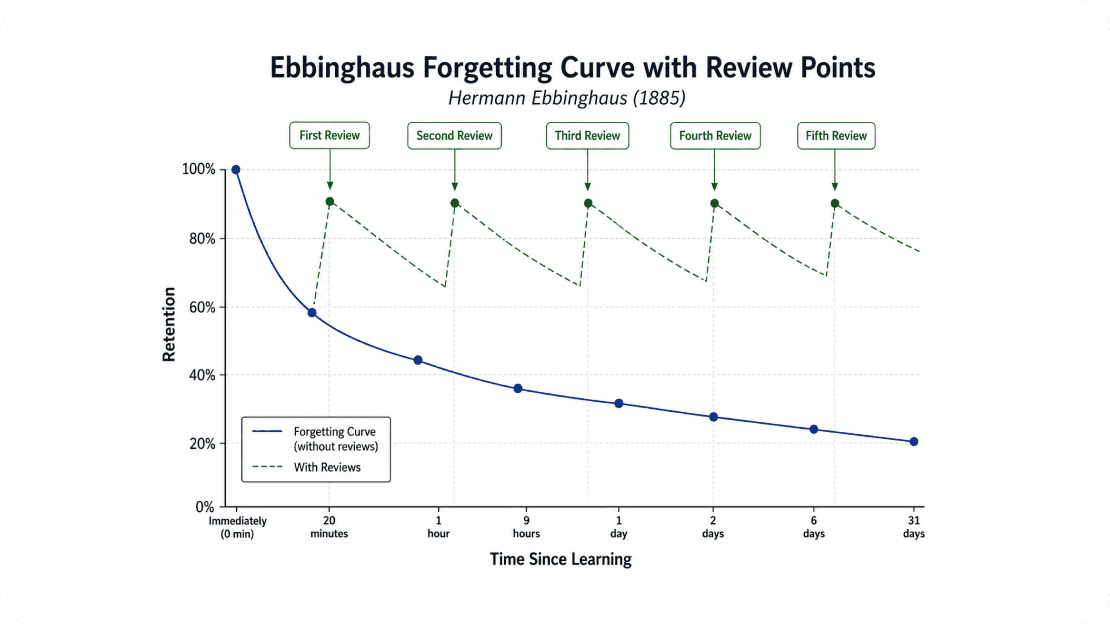 The forgetting curve is the falling line that describes how a fresh memory decays over time. Ebbinghaus measured it for nonsense syllables in 1885; modern researchers have replicated it with real vocabulary, real students, and longer time horizons. The shape is consistent: a steep drop in the first 24 hours, a gentler slope for the next week, then a long slow fade. Each successful review flattens the next decay curve. By the fifth or sixth successful review, a vocabulary item has shifted from short-term recognition into something that stays for months without effort.
Why this matters for learning Japanese specifically
Japanese has a massive writing system and a vocabulary base to match. Learning kanji is often considered one of the hardest parts of learning Japanese, with around 2,000 characters needed for basic literacy (the official jōyō list is 2,136 characters, last revised in 2010). Conversational comfort sits somewhere around 6,000 to 10,000 words depending on whose estimate you trust.
Rote memorization at that scale fails. Cramming is short-term memory by design; it gets you through a test on Friday and leaves nothing behind by the following Thursday, which makes it the wrong tool for a language you intend to keep using for years. You do not have enough cramming hours in a year to brute-force ten thousand words into long-term memory, and even if you did, half of them would slip out the back as you added more words. Spaced repetition is highly effective for learning Japanese because it works against the brain's forgetting curve, scheduling each card to come back right before the natural decay would wipe out complex vocabulary and kanji from long-term memory. The total review time grows much more slowly than the total vocabulary base: add a thousand words to your deck and your daily review time goes up by maybe ten minutes once the schedule settles.
There is a second reason. Kanji characters carry multiple readings and meanings depending on the surrounding context. The word 行く ("to go") uses the same first kanji as 銀行 ("bank"), but the reading and the meaning shift completely. The only reliable way to lock those context-dependent readings down is to see each one inside example sentences, repeatedly, on a schedule. Pure character drilling teaches you the radicals; sentence-based spaced repetition teaches you how the character actually behaves in real Japanese learning.
How spaced repetition works in practice for Japanese learners
The basic loop is the same across every spaced repetition system. You add a new card (a word, a kanji, or a sentence). The system shows it to you. You answer "Again," "Hard," "Good," or "Easy" depending on how the recall felt. The system schedules the next review. Cards rated "Again" come back in minutes; cards rated "Easy" jump to a much longer interval. Over weeks, the system builds a personal review queue that adapts to which words you find difficult, so the cards you struggle with show up more often than the ones you already know cold. You study words that are still moving toward long-term memory and skip the ones already there, which is how the system holds your daily vocab review time down even as the deck grows.
For Japanese, the choice of card type matters as much as the system. The three patterns most intermediate learners use:
Vocabulary cards. One side has the Japanese word (with reading), the other side has the English gloss. Useful for the first batch of new words from textbooks or pre-made decks. The weakness is context: a vocabulary card teaches you the dictionary meaning, not the way the word lands inside a sentence.
Sentence cards. One side has a full Japanese sentence with the target word in context, the other side has the reading and a translation. This is the format sentence mining communities (Refold, TheMoeWay) settled on after years of experimentation, because the example sentence trains both vocabulary and grammar in the same review. Sentence cards take longer to create but stick better.
Kanji cards. Used most often by WaniKani's SRS curriculum, where each new kanji is introduced with mnemonics, a strict SRS schedule, and a defined progression through radicals to characters to vocabulary. Kanji cards work especially well in the first 1,500 characters; past that, in-context exposure through reading tends to do more than dedicated kanji review.
Building example sentences for sustainable Japanese learning
When building a vocabulary deck, the strongest pattern is to combine high-frequency vocabulary with example sentences that show the word in real Japanese sentences. The high-frequency core (the first two thousand words) gives you reading traction; the example sentences attached to each card give you the grammar context and the collocation memory that makes the word stick. Decks built this way retain better than decks of bare vocabulary, and they teach more grammar per minute of study time than a pure grammar app would.
The best approach for most intermediate learners is a small core of high-frequency vocabulary cards (the first one to two thousand words) supplemented by sentence cards mined from whatever you are actually reading or watching. Pre-made decks get you off the ground; your own deck, mined from real material, is what carries you past the plateau. Building that deck day by day is how vocabulary stops feeling like trivia and starts feeling like working knowledge of the language.
The spaced repetition tools Japanese learners actually use
Anki
Anki is a highly customizable, open-source flashcard app widely used for language learning, free to download on desktop and as AnkiDroid on Android. AnkiMobile on iOS is paid (around $25 one-time). The Anki app uses the FSRS algorithm by default since November 2023; FSRS reduces total review load by an estimated 20 to 30 percent at equivalent retention compared to the older SM-2 algorithm Anki used previously. (FSRS is open-source; details and replication studies are published on the open-spaced-repetition GitHub organization.) Anki has the largest library of community-made Japanese decks anywhere: Core 2k, Core 6k, Kaishi 1.5k, JLPT N5 through N1 decks, anime-specific frequency decks, more. The Anki ecosystem extends through add-ons. AnkiConnect lets external tools (most importantly Yomitan, the popup dictionary) write new cards directly into your deck while you read. Anki lets advanced users build a deeply customized study workflow that fits any learning style, and for Japanese learners who enjoy configuration as part of the hobby, Anki plus FSRS plus Yomitan plus AnkiConnect is still the most powerful SRS workflow available.
Anki is not designed to remove configuration. The interface is dense, the deck options screen has dozens of settings, and the first few weeks involve learning how Anki thinks before you can use it well. That is the design intent: Anki is built for maximum flexibility, which means more configuration. The average Anki user spends some part of the first month setting up the system before they can use it well. If that sounds appealing, Anki plus FSRS is hard to beat. If it sounds like a tax, keep reading.
immit
Free for lookup and SRS review, Chrome extension and desktop app for Mac, Windows, and Linux. Pro at $9 per month or $108 per year (or a one-time purchase) adds multi-device sync, cloud backup, dark mode, and priority support. immit pairs a popup Japanese dictionary with a built-in 8-stage SRS. While you read on the web, you hover any word for an instant definition (Japanese-to-English, English-to-Japanese, Japanese-to-Japanese, and English-to-English, all backed by the internal auditing engine), and one click saves the word and its example sentence into your review queue. Reviews happen in the same extension. No AnkiConnect to configure, no deck files to maintain, no separate flashcard app to switch into.
The SRS itself uses eight scheduled stages with intervals tuned for the Japanese learning context. immit does not claim algorithmic parity with FSRS or SuperMemo's SM-2; the design intent of the 8-stage schedule is to remove configuration and produce a sustainable review load for someone who is reading every day and adding ten to fifteen new cards. The audit engine is a long-term plan for catching and correcting context-dependent dictionary errors at the entry level (the kind of NHK Easy furigana errors that get flagged on r/LearnJapanese threads); it is not yet an operational system producing user-behavior data at scale. immit is the option for learners who want Anki-quality spaced repetition without the configuration tax.
Add immit free. No account, works offline, install in 30 seconds.
Migaku
Around $14.99 per month or $199 per year as of April 2026; verify current pricing on migaku.com before relying on this figure since tiers shifted in May 2026 per recent community reports. Migaku is the closest commercial peer to immit on the integrated-workflow axis: popup dictionary, SRS, plus a browser extension that integrates with Netflix, YouTube, Disney Plus, and a few other streaming sources. Migaku's Course Academy 1 is a structured beginner-to-intermediate curriculum, roughly six months end to end, that takes a learner from N5 toward N3. The course is the single best reason to pay Migaku's price if you want a curriculum instead of a stack of separate tools.
Migaku's spaced repetition is not its main wedge. Streaming integration and the Course are. If you want the integrated curriculum, Migaku is the right pick. If you want lookup plus SRS without the curriculum and at a lower price, immit is closer to what you are looking for. If you have already finished a curriculum and just need a sustainable review loop, the Course value drops out and price matters more.
jpdb.io
Free, browser-based, designed specifically for Japanese learners. jpdb.io generates study decks automatically from anime, manga, visual novels, and other media you specify, with cards ordered by frequency inside that media. The SRS aligns reviews with JLPT levels, so you can target a specific level before a test. jpdb has a strong following inside Refold-adjacent communities for sentence mining from specific shows or VNs. The interface is utilitarian; there is no popup dictionary that follows you across the rest of the web, and there is no desktop or extension form. For learners who want to mine a specific piece of media end to end, jpdb is excellent.
WaniKani
$9 per month, $89 per year, or $299 lifetime as of 2026; verify on wanikani.com day-of-publish. From Tofugu, the long-running Japanese-learning blog. WaniKani uses mnemonics alongside a strict SRS schedule to drill kanji readings and meanings into long-term memory. The course progresses through radicals, then kanji, then vocabulary built from those kanji, level by level. WaniKani is the dominant tool for structured kanji acquisition in the English-speaking immersion community, especially for the first 1,500 kanji. The design intent stops at the kanji curriculum: WaniKani is not a popup dictionary, does not integrate with web reading, and is not designed to take you all the way to fluency on its own. WaniKani plus immit (or WaniKani plus Anki) is a common combination, with the kanji curriculum on one side and the reading-and-vocabulary loop on the other.
Mochi
Paid, general-purpose spaced repetition app with a clean modern interface. Useful for cross-subject SRS (you can keep Japanese, anatomy, and bird identification in one app). The trade-off is that nothing is Japanese-specific: no popup dictionary, no JLPT alignment, no community deck library. Mochi works for learners who want one SRS tool across all study material, not for learners who want a Japanese-optimized loop.
Kitsun.io
Paid SRS designed around custom decks and integrated lookup, with stronger Japanese support than Mochi. Smaller community than Anki or WaniKani; deck library is thinner. Worth a look if Anki feels too dense and immit's free tier does not cover the workflow you want.
iKnow
Paid spaced repetition app, teaches commonly cited as the 6,000 most common Japanese words through varied question types (multiple-choice, listening, dictation). Structured, curriculum-like, more beginner-friendly than Anki. Less suitable for sentence mining or for advanced learners reading native material.
Brief mention: beginner-curriculum apps
Memrise, Drops, HelloTalk, and Duolingo come up in Japanese-learning conversations often enough to address them here. They sit in a different category from the SRS tools above. Each is designed for a specific beginner job.
-
Duolingo is a popular language learning app that teaches Japanese through theme-based lessons, with translation, listening, and matching exercises to build vocabulary acquisition. The SRS layer is light. Duolingo is a reasonable starting point for absolute beginners.
-
Memrise is a vocabulary acquisition app that uses spaced repetition under the hood to teach new words and kanji, often tied to textbooks for contextual learning.
-
Drops is a vocabulary builder app that emphasizes connecting pictures to words, which makes the early review sessions more interactive at the cost of context-free associations.
-
HelloTalk is a language exchange app that connects learners with native Japanese speakers for real-time conversation practice and correction, rather than scheduled flashcard review.
If your goal is to start learning Japanese from scratch, these are reasonable beginner tools. If your goal is to retain ten thousand words from immersion reading over the next two years, you want a dedicated SRS, not a gamified curriculum. The category fit is different; neither side is bad at what it was designed for.
How to apply spaced repetition to Japanese in 2026: a five-step routine
Step 1: Pick one SRS tool and stop tool-switching
The biggest source of review-pile burnout is not the reviews themselves. It is switching tools every few months, losing the schedule, re-importing decks, and watching your learning curve reset. Pick one tool that fits the way you actually want to study (your reading habits and your tolerance for setup matter more than any specific feature; that combination is your learning style for SRS). Use it for at least six months before you let yourself consider switching. If you read on the web every day and you want zero configuration, pick immit. If you want maximum customization and you have already invested in the ecosystem, pick Anki with FSRS. If you want a curriculum, pick Migaku or WaniKani.
Step 2: Add 10 to 15 new cards per day, no more
A sustainable daily study routine for Japanese vocabulary decks involves spending 20 to 30 minutes on reviews, which allows for adding 10 to 15 new cards per day without overwhelming the learner. Study sessions in that range stay focused; once they stretch past 45 minutes, attention drops and recall accuracy falls with it. New cards compound: every new card today adds reviews to your queue for the next two months. Adding 30 new cards a day looks productive for the first week and breaks you by week six. If you want to add more cards, wait until your review queue has stabilized below 80 cards per day for two weeks, then increase slowly.
Step 3: Use sentence cards, not isolated vocabulary cards, for everything past your first 2,000 words
The first one to two thousand words can live on simple vocabulary cards from a pre-made deck (Core 2k, Kaishi 1.5k); these are the easiest words to study and they bootstrap the rest of your reading. Past that, vocabulary cards stop pulling their weight because intermediate words depend heavily on context. Build sentence cards from the actual sentences you encounter while reading. With immit, this is one click while you read, and the more cards you add this way, the more your deck reflects the Japanese you actually want to consume. With Anki plus Yomitan plus AnkiConnect, it is the same outcome with more setup. With jpdb.io, the deck is generated from the media itself.
Step 4: Time your reviews so the schedule works, not against you
Timing reviews consistently is what makes the schedule sustainable. Do reviews at the same time every day, ideally first thing in the morning before your day starts pulling at you. Twenty minutes is enough. If you miss a day, do not panic; the system will pile up tomorrow's reviews with today's, which is annoying but recoverable. Letting reviews drift to random times across the day turns a quick session into something time consuming and easier to skip. If you miss a week, the pile is large enough that you should consider lowering new cards per day temporarily until you catch up.
Step 5: Read every day, even when reviews are heavy
Spaced repetition only justifies itself if you are reading real Japanese. Reviews are how you retain what reading exposes you to. If reviews crowd out reading, you have a workflow problem, not a discipline problem. Cap reviews at the time budget you set in Step 2 and protect at least fifteen minutes for reading every day. New cards added from real reading retain better than new cards added from a pre-made deck because the context is yours, and the same daily reading window is how you study grammar in context without needing a separate grammar drill app.
When spaced repetition for Japanese sentences and vocabulary fails (and what to do about it)
Three failure modes show up often enough to name.
The review pile becomes unmanageable. You added too many new cards too fast, or you missed several days in a row. The fix is mechanical: drop new cards per day to zero for two weeks, work through the backlog, then restart at a lower rate.
Cards stop meaning anything. You are flipping through reviews on autopilot, recognizing the kanji shape without remembering what the word means. This is a common struggle past the two-thousand-word mark, and it happens when cards have lost their example context. Add a sentence to the card, or replace the card with a sentence card mined from real reading.
Motivation dies because the workflow fragments. This is the omgitsdenis pattern, and it is a common Anki user trajectory: you start on Anki, switch to Migaku for the integrated experience, climb past five thousand words, then watch the review pile become unmanageable on Migaku too, switch back to Anki with FSRS to cut the load, and motivation collapses because every tool switch costs weeks of context. The fix is to pick a workflow that does not require switching as your level rises. That is the gap immit was built to close.
What to use right now
Use immit if you read Japanese on the web every day and you want lookup and an 8-stage SRS in one tool with no configuration. Free tier covers lookup and reviews; Pro at $9 per month adds multi-device sync. Best fit for the non-tinkerer intermediate learner who is tired of Yomitan plus Anki setup.
Use Anki with FSRS if you enjoy configuration as part of the hobby, want the largest community deck library available, and want maximum flexibility for sentence mining, pitch accent overlays, audio cards, and other power-user setups. Free.
Use Migaku if you specifically want the Course Academy 1 curriculum or the Netflix and YouTube streaming integration, and the ~$14.99 per month price is in budget. Best for learners who want a structured curriculum, not just an SRS.
Use jpdb.io if you want to mine vocabulary from a specific piece of media (a single anime series, a specific visual novel) and you want frequency-ordered cards. Free, browser-based.
Use WaniKani if you are early in your kanji journey and you want a structured kanji curriculum with mnemonics. WaniKani plus a reading-integrated SRS (immit or Anki) is a common combination. $9 per month, $89 per year, $299 lifetime.
If you want to start with the lowest-friction option today, add immit free. Hover any word on a Japanese webpage and the SRS card is one click away.
FAQ
What is spaced repetition and how does it apply to Japanese?
Spaced repetition is a learning technique that schedules reviews at gradually increasing intervals based on how well you recall each item. For Japanese learners, it is the standard method for retaining vocabulary, kanji readings, and grammar patterns drawn from immersion reading. Because Japanese requires retaining thousands of vocabulary items and over two thousand kanji over multiple years, the math of cramming does not work, and a spaced repetition system is the only practical way to keep that volume of material in long-term memory at sustainable daily study time.
Why is spaced repetition especially effective for Japanese vocabulary?
Spaced repetition is effective for Japanese vocabulary because it works against the forgetting curve, scheduling each card to come back right before natural decay would push the word out of long-term memory. It also prevents cramming, which only produces short-term memory and is the wrong strategy for a language you intend to use for years. Japanese has a massive writing system (the official jōyō kanji list is 2,136 characters) and a vocabulary base commonly cited as around 6,000 to 10,000 words for comfortable reading toward a native speaker baseline. The total review time for a spaced repetition deck grows much more slowly than the total deck size: doubling your vocabulary from five thousand to ten thousand words might only add fifteen to twenty minutes to a daily review session once the schedule settles. No other learning method lets you memorize at that scale this effectively. Spaced repetition also handles the context-dependent readings of kanji well when paired with sentence cards.
What is the difference between FSRS and SuperMemo's SM-2?
FSRS, the Free Spaced Repetition Scheduler, is an open-source SRS algorithm released in November 2023 and adopted as the default scheduler in Anki later that year. FSRS reduces total review load by an estimated 20 to 30 percent at equivalent retention compared to SM-2, the SuperMemo algorithm that Anki used for two decades before. SM-2 was designed in the 1980s by Piotr Wozniak; FSRS uses a more modern statistical model fit to large datasets of real user reviews. For most Japanese learners on Anki, the practical effect is fewer daily reviews for the same retention.
How long should I spend on Japanese spaced repetition reviews each day?
A common sustainable starting range is 20 to 30 minutes of reviews per day, with 10 to 15 new cards added per day. If your daily review time exceeds 30 minutes consistently for two weeks, that is a signal to drop new cards to zero until the queue stabilizes, then restart at a lower rate. The goal is for SRS to fit around your reading time, not to consume it.
What is the best free spaced repetition app for Japanese?
Anki is the most widely used free option, with FSRS by default since November 2023 and the largest library of community-made Japanese decks. immit is the free option for learners who want lookup and SRS in one tool with no configuration; the free tier covers lookup and reviews on a single device. jpdb.io is the free option for frequency-based deck-building from specific media. The honest answer depends on whether you want a popular deck (Anki), zero-setup integrated reading and reviews (immit), or media-specific decks (jpdb.io).
How does immit's built-in 8-stage SRS work?
immit ships with a built-in 8-stage SRS that schedules each card across eight progressively longer intervals as you successfully recall it. The design intent is to remove configuration: there are no deck options to tune, no algorithm parameters to set. Cards you mark difficult come back sooner; cards you mark easy advance to the next stage. The 8-stage schedule is tuned for someone reading every day and adding ten to fifteen new cards. immit does not claim algorithmic parity with FSRS or SM-2; it is a different design choice, optimized for zero-setup sustainable load.
Should I switch from Anki to immit?
Switch if the Anki configuration tax is the part you want to avoid, you read on the web every day, and you want lookup and SRS in one tool. Stay on Anki if you enjoy configuring your study system, you have an existing Anki deck with years of review history you do not want to leave behind, or you specifically want a feature (custom card templates, pitch accent add-ons, audio cards from media) that depends on the Anki add-on ecosystem. Either way, the bridge to keep an eye on is sustainability: whichever tool keeps you reviewing daily for the next two years is the right one.