Anki burnout: why it happens and the fix that actually lasts (2026)
You know the feeling. You open Anki, the counter says 340 reviews due, and you close it without doing a single card. Tomorrow it says 520. You spent two years building a Japanese Anki deck you were proud of, and now the thought of opening the app makes you want to do literally anything else. Digital flashcards were supposed to make learning Japanese easier. Somewhere along the way, studying flashcards became the whole hobby.
That is Anki burnout. If you are learning Japanese, you are in the highest-risk group there is. This post covers why it happens, why switching to another flashcard app usually doesn't fix it, and what a sustainable setup looks like for intermediate learners who want to keep reading Japanese without dreading their review queue.
Anki burnout is mental exhaustion caused by a review load that grows faster than your motivation. It is not laziness, and it is not proof that spaced repetition stopped working. Anki's algorithm is doing exactly what a spaced repetition system is designed to do: show each Anki card just before you would forget it, so the word moves into long-term memory with the fewest possible reviews. The research behind spaced repetition flashcards is solid. One frequently cited line of studies on medical students, the heaviest flashcard users anywhere, measured exam scores roughly 6 to 11 percent higher for spaced repetition users. And in the Japanese learning community, spaced repetition is how many learners hold onto vocabularies of 10,000 words and more.
The problem is not the algorithm. The problem is what we feed it.
Japanese learners hit this wall harder than most language learners for a structural reason. Kana takes about two weeks. Then the real mountain starts: over 2,000 kanji for basic literacy and thousands of Japanese words written in them. Almost nobody starting a new language like Spanish maintains a deck the size Japanese demands. Japanese study is uniquely deck-heavy, so it is uniquely burnout-prone.
Burnout follows a recognizable four-stage arc, and versions of it show up in r/LearnJapanese threads every month.
Stage 1: the honeymoon. You download a shared deck built by other learners, often the Japanese Core 2000 or a 6k/10k variant, set your new cards to 20 a day, and feel unstoppable. The first two months of any Japanese Anki deck are the easiest they will ever be.
Stage 2: the debt comes due. Adding new flashcards is a loan against future you. Around the 2,000 to 3,000 word mark, the reviews scheduled by months of steady adding start stacking up. Intermediate learners commonly report 200 to 400 reviews a day. Skip two days for work or travel and the backlog turns into a number you negotiate with instead of a habit you keep.
Stage 3: the tool switch. Convinced the app is the problem, you move to other tools: a different flashcard app, or a paid all-in-one platform. It feels better for a while, sometimes long enough to make real progress.
Stage 4: the quiet quit. The same pile builds in the new tool. You go back to Anki because at least it was free, stare at a four-digit backlog, and stop studying Japanese. Not deliberately. You just stop.
I got as far as stage 3 myself before we started building immit, and the pattern above is the reason immit exists. But before the fix, it helps to understand why the pile forms at all.
Shared decks are a real gift to absolute beginners, and the huge library of community decks is one of Anki's best features. Past the beginner stage, they become the main burnout engine. An Anki card for a word you have never encountered in native material is pure rote memorization: there is no experience attached, so active recall has nothing to grab. You are not reviewing a memory, you are manufacturing one from an English translation and a frequency rank. Those cards fail more often, which schedules them more often, which is how a "20 new cards a day" habit becomes a 400-review morning.
Good flashcards test one idea at a time. Decks built from your own notes tend to accumulate cards that bundle a word, two readings, and a couple of grammar patterns into one prompt. Cards that complex cause frustration and motivation loss during reviews: they fail on whichever piece is weakest, so the whole card keeps coming back, and each lapse feels like losing ground you already covered. If you are making flashcards yourself, the fix is mechanical. Split them until each card tests one key concept.
Anki's scheduler assumes you show up daily. Life doesn't. A missed weekend adds two days of scheduled reviews on top of Monday's, and clearing a backlog under time pressure produces sloppy answers, which produces more near-term reviews. The math of the backlog is the single most demoralizing thing about the app.
Anki gives you real tools for all of this, and it deserves credit for them. It is free and open source, it runs on Windows, Mac, Linux, iOS, and Android (the desktop version and the Android app cost nothing), and its cards can carry images and audio recordings alongside text. You can lower your new-cards-per-day limit, suspend or delete low-value cards, and enable the FSRS scheduler, which since 2023 has cut review counts substantially at the same retention. The standard advice from the community helps too: study flashcards in shorter sessions instead of one grinding block, take a planned break when your mental energy is gone, and keep a balance between Anki and other study methods like reading and listening, so reviews never become the whole of your Japanese.
Power users who enjoy this tuning can make the whole Anki experience sustainable, and if that describes you, tune it and keep going. The learners who burn out are mostly not those people. They wanted to read Japanese, and somewhere along the way they became deck administrators instead.
Most lists of the best tools to replace Anki recommend general-purpose study apps, each with unique features aimed at exam prep: Quizlet with its large library of millions of pre-created flashcard sets, RemNote, which combines your own notes and flashcards in one app, Brainscape with a confidence-based approach to optimizing review sessions, SuperMemo with over 300 ready-made courses for various languages, StudyStack, which gamifies flashcards into interactive activities for different learning styles, and AI tools like FlashRecall that turn any study material into cards automatically. These are capable apps for cramming key concepts before an exam. They are not designed for Japanese. None of them connects to a Japanese dictionary while you read, so you are back to typing English translations by hand or trusting someone else's sets. You changed the interface. You kept the pipeline.
The serious version of the switch is Migaku, and it deserves a serious look. As of July 2026 it costs $19.99 a month or $199 a year, and it earns real parts of that: the reading and video workflow is well built, and the Academy course is a legitimately good structured curriculum. If you want a guided path from beginner through lower intermediate, Migaku's course is a real reason to pay for it. We wrote a full honest review of Migaku that goes deeper.
Here is the part the pricing page can't solve. The pattern that keeps appearing in community threads goes like this: a learner plateaus on Anki around a couple thousand words, switches to an integrated platform, and the smoother mining workflow roughly triples their vocabulary over the next year or two. Then the review pile crosses the same threshold it crossed in Anki, except now the cards live in a subscription tool. They migrate back to Anki, lose momentum in the move, and their study habit dies in the gap between tools.
The review pile is not a property of the app. It is a property of the pipeline: mass card creation on one side, no reading loop on the other. Any tool fed that way produces the same pile. That is why the fix is not a better flashcard app.
The fix is a shorter pipeline: look up, save, and review in one tool, with your reading setting the pace.
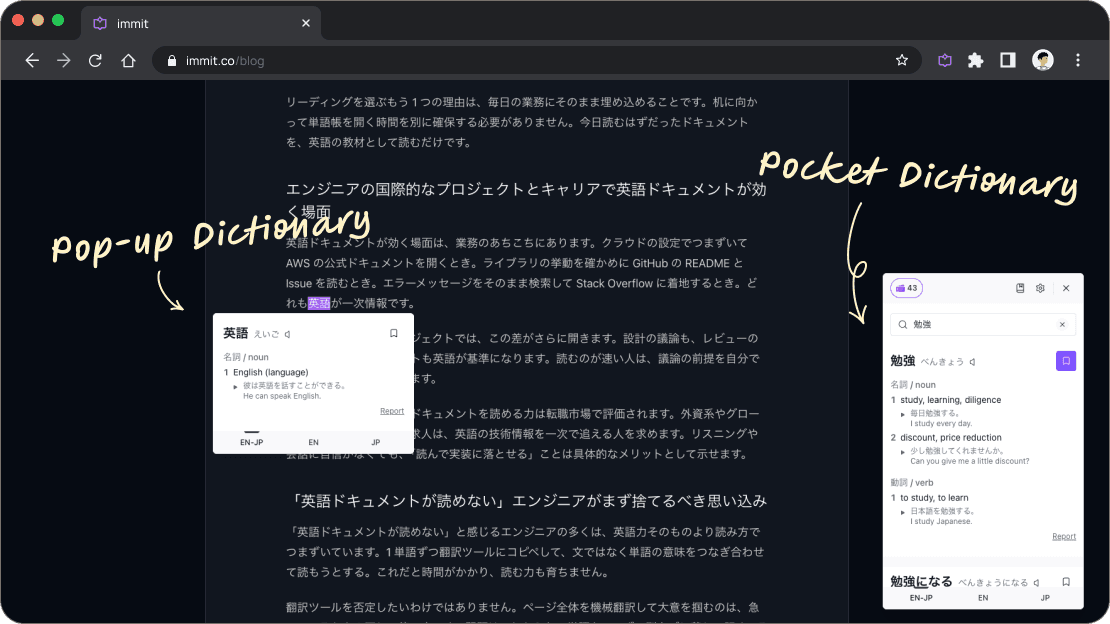
This is the design idea behind immit. immit is a popup Japanese dictionary for Chrome and desktop (Mac, Windows, Linux) with FSRS spaced repetition built in. You hover a word while reading, the definition appears right there, and saving it is one click. There is no AnkiConnect chain, no deck configuration, no manual setup, and no account required. Structurally, this changes the burnout math in three ways.
Every Japanese word you save starts as an encounter. One-click save turns a lookup into your own flashcards: the front is the word, the back carries the part of speech, the definition, an example sentence, and pronunciation, and the sentence and page you met it on are saved with the card. It is sentence mining reduced to a click, and it means you learn vocabulary from native material you chose, not from rows in a frequency list. Words with a real memory attached give active recall something to hold.
Your reading volume sets your card pace. There is no deck of 6,000 strangers waiting to be scheduled; the queue grows only as fast as you read, which keeps it matched to your Japanese level. If it ever feels heavy, pick a 5- or 15-minute session and immit lines up the cards that matter most today, or save fewer words for a week and let it settle. That is the whole pacing system, and it is self-correcting in a way a new-cards-per-day slider is not.
Everything you save lands in one deck, a single inbox for words mined from web pages, YouTube captions, and web novels, and reviews happen in the same tool, as flip cards or type-in recall, with no card limits and full offline support. Because lookup and SRS live together, there is no point where the bridge between your dictionary and your own deck collapses and takes your habit with it. The Pocket Dictionary, a pinned window in the corner of the page, adds active search and card review without leaving what you are reading.
immit is free: lookup, saving, and unlimited FSRS review, and syncing across devices is free too with an optional account. If you want to see whether the shorter pipeline fits how you study, add the extension (free, no account) and read something you like for a week.
The best Anki alternative for Japanese is a tool that combines dictionary lookup and spaced repetition instead of separating them. immit does this in one extension: hover lookup, one-click save, and FSRS spaced repetition built in. Learners who want prebuilt anime and novel decks should look at jpdb, and learners who want a structured course should look at Migaku. Generic flashcard apps like Quizlet, RemNote, and Brainscape are built for exam prep rather than Japanese, so they rarely hold up for this use case.
Volume. Japanese requires over 2,000 kanji and a vocabulary many learners build toward 10,000+ words, so Japanese decks grow several times larger than decks for European languages. Larger decks mean more daily reviews, bigger backlogs after missed days, and a heavier reliance on pre-made decks full of context-free cards.
There is no universal number; the warning sign is behavioral. If you feel dread before opening the app, clear reviews without reading the sentences, or skip days to avoid the counter, your load has outgrown your motivation, whatever the number says. Intermediate Japanese learners commonly report 200 to 400 daily reviews, and few people sustain that for years. Shorter, more frequent sessions hold up better than one long block.
It helps, and if you are staying with Anki you should enable it. FSRS schedules reviews more efficiently than the older algorithm and meaningfully cuts daily review counts at the same retention. It does not change where cards come from, so a deck fed by mass imports will still outgrow you. FSRS buys time rather than fixing the pipeline.
Sometimes temporarily. Migaku's integrated workflow removes real friction, and its Academy course is a real strength. But the review-pile problem follows the learner across other platforms, and the pattern reported in community threads is a strong run followed by the same wall, now at $19.99 a month. If burnout is your core problem, changing how cards get created matters more than changing where.
Take a real break first; a week or two fully away from reviews resets mental energy and focus. Then do not reopen the old deck. A four-digit backlog is a motivation killer, and those words will resurface as you read anyway. Start from reading instead: pick native material slightly below your old Japanese level, look words up as you go, and let a small review queue rebuild from what you actually encounter. NHK News Web Easy, graded readers, and visual novels are all good re-entry points.